20:30, Park Theatre
Fabla (SI): Kükan 45’
Concept, performance and set design: Inan Sven Du Swami, Mojca Špik
Music: Zhlehtet Live Band – Rok Zalokar: composer, piano, electronica; Lenart De Bock: sax, flute; Boštjan Simon: sax; Kristijan Kranjčan: cello, drums; Žiga Smrdel: drums
Costume design: Iztok Hrga
Set design and technical realisation assistance: Larisa Kazić
Lighting design: Gregor Kuhar
Set construction: Matjaž Mandelc, Protovipa
Production: Fabla Collective
Co-production: Cankarjev dom, Hiša otrok in umetnosti
Supported by: the Ministry of Culture of the Republic of Slovenia and the City of Ljubljana.
Kūkan is a Japanese concept and way of thinking about space.
It can be understood as a space with a clear frame that gives it form and dimension – something that can be physically measured. At the same time, it is a field of emptiness that emerges between objects, bodies, or thoughts. One understanding sees space as something that holds, while the other sees it as something that opens. These two aspects intertwine and coexist. It is within this multilayered understanding that kūkan becomes a living, constantly shifting space.
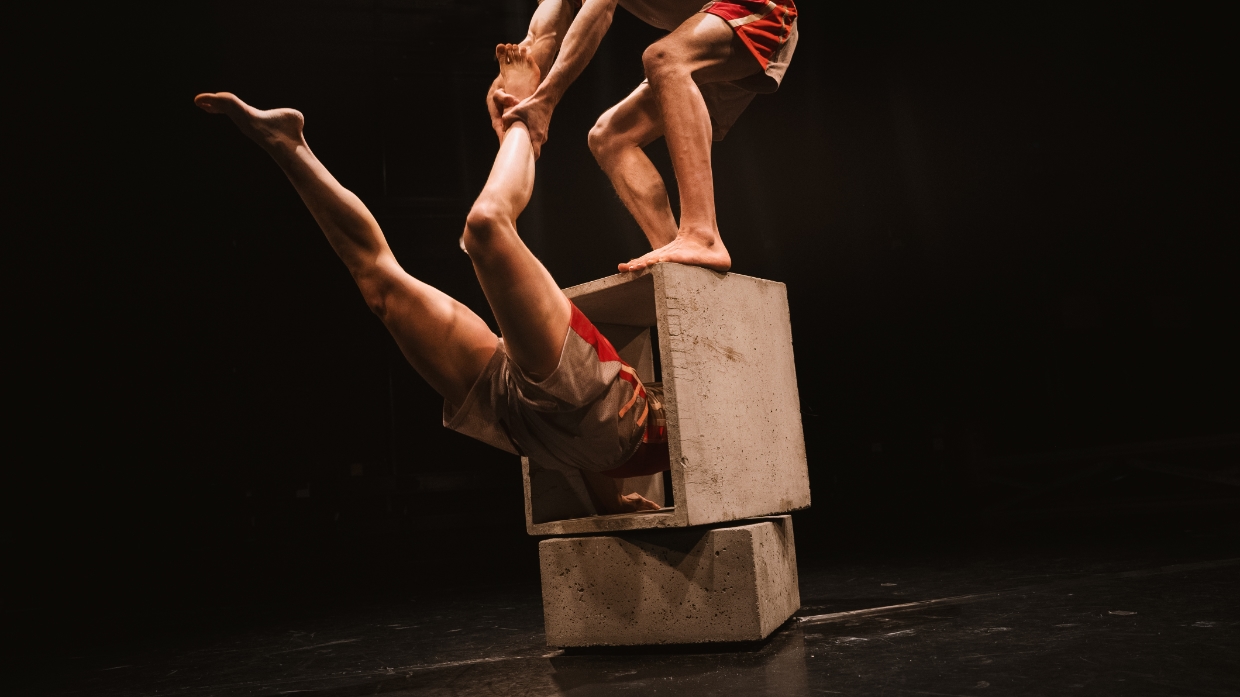
Supporting one another through collaboration, the two performers create possibilities for movement that did not previously exist. Standing on a small concrete block that constantly tests their balance and compels them to negotiate with their own bodies, they explore how kūkan ceases to be merely a philosophical concept and becomes a practical exploration of space. The performance consciously embraces limitation as a creative challenge. The relationship that unfolds on the block reveals the moment when a boundary becomes a possibility.
Fabla Collective is the artistic collaboration of Inan Sven Du Swami and Mojca Špik. In their work, they bring together circus techniques, dance, and physical theatre to explore the relationship between the body and the object. They are currently focused on developing kinetic and dynamic stage structures that enable them to experiment with new modes of movement. Their circography emerges through a dialogue with materials and structures, where the intuition of movement meets the logic of engineering.
Fabla Collective was selected for the 2026 Aerowaves programme. Aerowaves is supported by the Creative Europe programme, which promotes the development of emerging European artists.
__________
Jacopo Jena (IT): Manifestus 40’
Concept, direction, choreography: Jacopo Jenna
Choreographic collaboration: Mattia Quintavalle SLY
Dance: Simone De Giovanni, Petra Audrey Mangoua Youaleu, Phex
Sound: Alberto Ricca/Bienoise
Technical direction and lighting design: Mattia Bagnoli
Organisation: Luisa Zuffo
Production: Klm – Kinkaleri, Le Supplici, mk
Supported by: OperaEstate Festival, MilanOltre Festival, Fabbrica Europa.
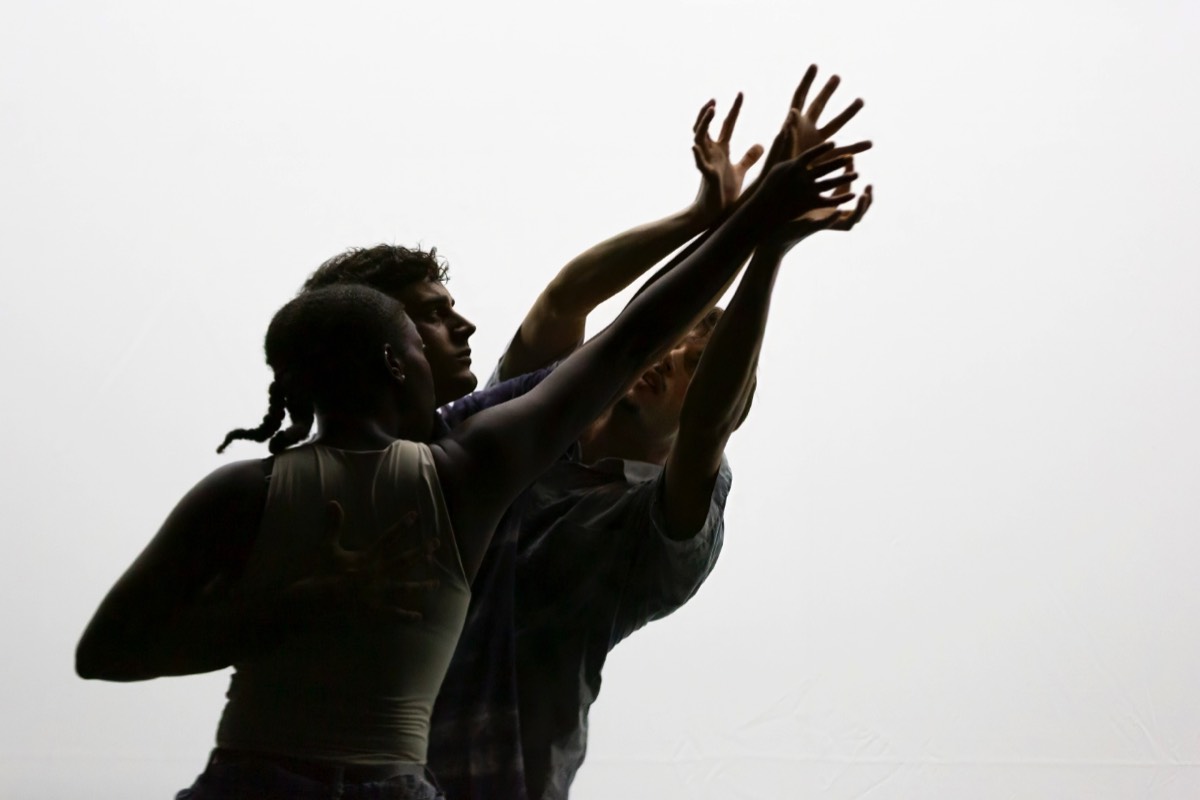
The hand has long been thought of as a conduit of power, which transforms invisible energy into the world of form. The Latin term MANIFESTUS (clear, evident) includes the word manus (mano in Italian) or hand.
Manifesting is the way of saying I AM HERE!, it is the moment in which we catch a fleeting stretch of reality, caught in the act, and present it to the evidence of the public, of the square, of others, with a concreteness that is held between the fingers. There is no break between thought, gesture and imagination: the hands create, shape both matter and ideas, they are the distinctive organ of the human race emancipated from the constraints of the animal world. They are faces without eyes, but seeing and speaking.
The work creates a shifting system of energy and form developing a choreography for a group of three dancers, researching an abstract form of representation, through codes and non-narrative references of some street dance practices, defining a complex energetic space in constant change to manifest itself dancing in the flow of the present.
The hands become expressive units in a choreography that can suggest everything or nothing, using the immediacy of street dance to engage the audience directly.
“The hand is action: it grasps, creates, sometimes it seems to think. In a state of rest, it is not a soulless tool, a tool abandoned on the table or left to fall along the body: in it, in the phase of reflection, the instinct and the will to act remain, and it is not necessary to linger long to intuit the gesture it is about to perform.”
In Praise of Hands – Henri Focillon